
KI-Beratung Beta

Gutscheinbedingungen

**Gültig am 25.11.2026 auf fremdsprachige Bücher online auf thaalia.live und in der Thalia App. Einzelne Artikel können ausgeschlossen sein. Ausgenommen sind preisgebundene Artikel & eBooks. Pro Einkauf einmal einlösbar. Click & Collect nur bei Onlinevorabzahlung möglich. Keine Barauszahlung. Nicht kombinierbar mit anderen Aktionen und Gutscheinen. Gutschein wird auf max. 500€ Bestellwert angerechnet. Nicht gültig für Geschenkkarten, Versandkosten und Services.

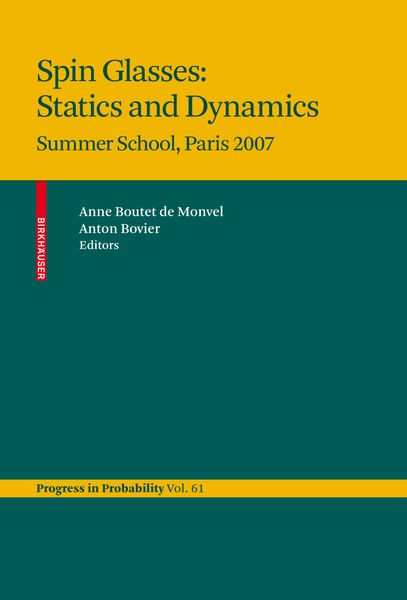
  • Produktbild: Spin Glasses: Statics and Dynamics
  • Produktbild: Spin Glasses: Statics and Dynamics
Band 62

Spin Glasses: Statics and Dynamics Summer School, Paris 2007

Aus der Reihe Progress in Probability

99,99 €

inkl. gesetzl. MwSt., Versandkostenfrei


Beschreibung

Over the last decade, spin glass theory has turned from a fascinating part of t- oretical physics to a ?ourishing and rapidly growing subject of probability theory as well. These developments have been triggered to a large part by the mathem- ical understanding gained on the fascinating and previously...

Beschreibung

Over the last decade, spin glass theory has turned from a fascinating part of t- oretical physics to a ?ourishing and rapidly growing subject of probability theory as well. These developments have been triggered to a large part by the mathem- ical understanding gained on the fascinating and previously mysterious “Parisi solution” of the Sherrington–Kirkpatrick mean ?eld model of spin glasses, due to the work of Guerra, Talagrand, and others. At the same time, new aspects and applications of the methods developed there have come up. The presentvolumecollects a number of reviewsaswellas shorterarticlesby lecturers at a summer school on spin glasses that was held in July 2007 in Paris. These articles range from pedagogical introductions to state of the art papers, covering the latest developments. In their whole, they give a nice overview on the current state of the ?eld from the mathematical side. The review by Bovier and Kurkova gives a concise introduction to mean ?eld models, starting with the Curie–Weiss model and moving over the Random Energymodels up to the Parisisolutionof the Sherrington–Kirkpatrikmodel. Ben Arous and Kuptsov present a more recent view and disordered systems through the so-called local energy statistics. They emphasize that there are many ways to look at Hamiltonians of disordered systems that make appear the Random Energy model (or independent random variables) as a universal mechanism for describing certain rare events. An important tool in the analysis of spin glasses are correlation identities.

Produktdetails

Einband

Gebundene Ausgabe

Erscheinungsdatum

18.09.2009

Abbildungen

XII, 278 p.

Herausgeber Anne Boutet de Monvel + weitere

Produktdetails

Einband

Gebundene Ausgabe

Erscheinungsdatum

18.09.2009

Abbildungen

XII, 278 p.

Herausgeber
Verlag Springer Basel
Seitenzahl

278

Maße (L/B/H)

24,1/16/2,2 cm

Gewicht

554 g

Auflage

1. Auflage

Sprache

Englisch

ISBN

978-3-7643-8999-4

Herstelleradresse

Springer Nature c/o IBS
Benzstrasse 21
48619 Heek
DE

Email: Tanja.Keller@springer.com

Noch keine Bewertungen vorhanden

Verfassen Sie die erste Bewertung zu diesem Artikel

Helfen Sie anderen Kundinnen und Kunden durch Ihre Meinung.

Kundinnen und Kunden meinen

Bewertungen (0)

  • Produktbild: Spin Glasses: Statics and Dynamics
  • Produktbild: Spin Glasses: Statics and Dynamics
  • Mean Field.- A Short Course on Mean Field Spin Glasses.- REM Universality for Random Hamiltonians.- Another View on Aging in the REM.- Spin Glass Identities and the Nishimori Line.- Self-averaging Identities for Random Spin Systems.- Chaos in Mean-field Spin-glass Models.- A non Gaussian Limit Law for the Covariances of Spins in a SK Model with an External Field.- A Limit Theorem for Mean Magnetisation in the Sherrington-Kirkpatrick Model with an External Field.- Non-mean Field.- A Percolation-theoretic Approach to Spin Glass Phase Transitions.- Fluctuations in Finite-dimensional Spin-glass Dynamics.- Disordered Pinning Models.- Renewal Sequences, Disordered Potentials, and Pinning Phenomena.- A Smoothing Inequality for Hierarchical Pinning Models.