KI-Beratung Beta

Gutscheinbedingungen

**Gültig am 25.11.2026 auf fremdsprachige Bücher online auf thaalia.live und in der Thalia App. Einzelne Artikel können ausgeschlossen sein. Ausgenommen sind preisgebundene Artikel & eBooks. Pro Einkauf einmal einlösbar. Click & Collect nur bei Onlinevorabzahlung möglich. Keine Barauszahlung. Nicht kombinierbar mit anderen Aktionen und Gutscheinen. Gutschein wird auf max. 500€ Bestellwert angerechnet. Nicht gültig für Geschenkkarten, Versandkosten und Services.

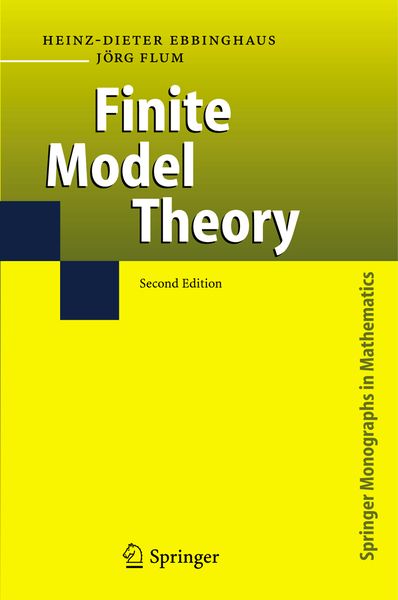
Produktbild: Finite Model Theory
- 12%

Finite Model Theory Second Edition

12% sparen

173,99 € UVP 197,99 €

inkl. gesetzl. MwSt., Versandkostenfrei


Beschreibung

Finite model theory, the model theory of finite structures, has roots in clas sical model theory; however, its systematic development was strongly influ enced by research and questions of complexity theory and of database theory. Model theory or the theory of models, as it was first named by Tarski in...

Beschreibung

Finite model theory, the model theory of finite structures, has roots in clas sical model theory; however, its systematic development was strongly influ enced by research and questions of complexity theory and of database theory. Model theory or the theory of models, as it was first named by Tarski in 1954, may be considered as the part of the semantics of formalized languages that is concerned with the interplay between the syntactic structure of an axiom system on the one hand and (algebraic, settheoretic, . . . ) properties of its models on the other hand. As it turned out, first-order language (we mostly speak of first-order logic) became the most prominent language in this respect, the reason being that it obeys some fundamental principles such as the compactness theorem and the completeness theorem. These principles are valuable modeltheoretic tools and, at the same time, reflect the expressive weakness of first-order logic. This weakness is the breeding ground for the freedomwhich modeltheoretic methods rest upon. By compactness, any first-order axiom system either has only finite models of limited cardinality or has infinite models. The first case is trivial because finitely many finite structures can explicitly be described by a first-order sentence. As model theory usually considers all models of an axiom system, modeltheorists were thus led to the second case, that is, to infinite structures. In fact, classical model theory of first-order logic and its generalizations to stronger languages live in the realm of the infinite.

Produktdetails

Einband

Gebundene Ausgabe

Erscheinungsdatum

06.10.2005

Verlag Springer Berlin
Seitenzahl

360

Produktdetails

Einband

Gebundene Ausgabe

Erscheinungsdatum

06.10.2005

Verlag Springer Berlin
Seitenzahl

360

Maße (L/B/H)

24,5/16,5/2,7 cm

Gewicht

733 g

Auflage

Second Edition 1995

Sprache

Englisch

ISBN

978-3-540-28787-2

Herstelleradresse

Springer-Verlag GmbH
Heidelberger Platz 3
14197 Berlin
Deutschland
Email: sdc-bookservice@springer.com
Url: www.springer.com
Telephone: +49 6221 3454301
Fax: +49 30 8214091

Noch keine Bewertungen vorhanden

Verfassen Sie die erste Bewertung zu diesem Artikel

Helfen Sie anderen Kundinnen und Kunden durch Ihre Meinung.

Kundinnen und Kunden meinen

Bewertungen (0)

  • Produktbild: Finite Model Theory
  • Preliminaries.- The Ehrenfeucht-Fraïssé Method.- More on Games.- 0-1 Laws.- Satisfiability in the Finite.- Finite Automata and Logic: A Microcosm of Finite Model Theory.- Descriptive Complexity Theory.- Logics with Fixed-Point Operators.- Logic Programs.- Optimization Problems.- Logics for PTIME.- Quantifiers and Logical Reductions.