KI-Beratung Beta

Gutscheinbedingungen

**Gültig am 25.11.2026 auf fremdsprachige Bücher online auf thaalia.live und in der Thalia App. Einzelne Artikel können ausgeschlossen sein. Ausgenommen sind preisgebundene Artikel & eBooks. Pro Einkauf einmal einlösbar. Click & Collect nur bei Onlinevorabzahlung möglich. Keine Barauszahlung. Nicht kombinierbar mit anderen Aktionen und Gutscheinen. Gutschein wird auf max. 500€ Bestellwert angerechnet. Nicht gültig für Geschenkkarten, Versandkosten und Services.

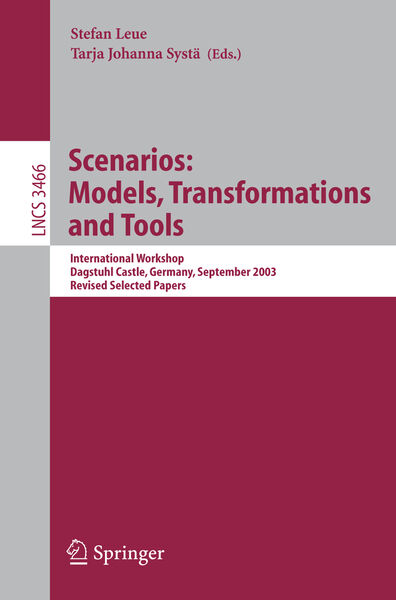
Produktbild: Scenarios: Models, Transformations and Tools
Band 3466

Scenarios: Models, Transformations and Tools International Workshop, Dagstuhl Castle, Germany, September 7-12, 2003, Revised Selected Papers

51,99 €

inkl. gesetzl. MwSt., Versandkostenfrei


Beschreibung

Visual notations and languages continue to play a pivotal role ˆ in the design of complex software systems. In many cases visual notations are used to - scribe usage or interaction scenarios of software systems or their components. While representing scenarios using a visual notation is not the only...

Beschreibung

Visual notations and languages continue to play a pivotal role ˆ in the design of complex software systems. In many cases visual notations are used to - scribe usage or interaction scenarios of software systems or their components. While representing scenarios using a visual notation is not the only possibility, a vast majority of scenario description languages is visual. Scenarios are used in telecommunications as Message Sequence Charts, in object-oriented system design as Sequence Diagrams, in reverse engineering as execution traces, and in requirements engineering as, for example, Use Case Maps or Life Sequence Charts. These techniques are used to capture requirements, to capture use cases in system documentation, to specify test cases, or to visualize runs of existing systems. They are often employed to represent concurrent systems that int- act via message passing or method invocation. In telecommunications, for more than 15 years the International Telecommunication Union has standardized the Message Sequence Charts (MSCs) notation in its recommendation Z. 120. More recently, with the emergence of UML as a predominant software design meth- ology, there has been special interest in the development of the sequence d- gram notation. As a result, the most recent version, 2. 0, of UML encompasses the Message Sequence Chart notation, including its hierarchical modeling f- tures. Other scenario-?avored diagrams in UML 2. 0 include activity diagrams and timing diagrams.

Produktdetails

Einband

Taschenbuch

Erscheinungsdatum

16.06.2005

Abbildungen

XII, 279 p.

Herausgeber Stefan Leue + weitere

Produktdetails

Einband

Taschenbuch

Erscheinungsdatum

16.06.2005

Abbildungen

XII, 279 p.

Herausgeber
Verlag Springer Berlin
Seitenzahl

279

Maße (L/B/H)

23,5/15,5/1,7 cm

Gewicht

452 g

Auflage

2005

Sprache

Englisch

ISBN

978-3-540-26189-6

Herstelleradresse

Springer-Verlag KG
Sachsenplatz 4-6
1201 Wien
AT

Email: ProductSafety@springernature.com

Noch keine Bewertungen vorhanden

Verfassen Sie die erste Bewertung zu diesem Artikel

Helfen Sie anderen Kundinnen und Kunden durch Ihre Meinung.

Kundinnen und Kunden meinen

Bewertungen (0)

  • Produktbild: Scenarios: Models, Transformations and Tools
  • Scenarios: Models, Transformations and Tools.- Why Timed Sequence Diagrams Require Three-Event Semantics.- Some Methodological Observations Resulting from Experience Using LSCs and the Play-In/Play-Out Approach.- Deciding Properties of Message Sequence Charts.- Operational Semantics of Security Protocols.- Autonomous Shuttle System Case Study.- Genetic Design: Amplifying Our Ability to Deal With Requirements Complexity.- Applying Story Driven Modeling to the Paderborn Shuttle System Case Study.- Traceability and Evaluation in Scenario Analysis by Use Case Maps.- Scenario-Based Statistical Testing of Quality of Service Requirements.- Lightweight Formal Methods for Scenario-Based Software Engineering.- Pattern Synthesis from Multiple Scenarios for Parameterized Real-Time UML Models.- Partial Order Semantics of Sequence Diagrams for Mobility.- From MSC to SDL: Overview and an Application to the Autonomous Shuttle Transport System.- Component Synthesis from Service Specifications.