
KI-Beratung Beta

  • Produktbild: Graph-Theoretic Concepts in Computer Science
  • Produktbild: Graph-Theoretic Concepts in Computer Science
Band 790

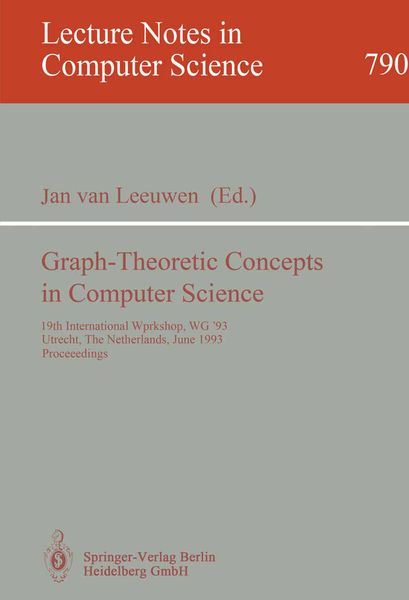
Graph-Theoretic Concepts in Computer Science 19th International Workshop, WG '93, Utrecht, The Netherlands, June 16 - 18, 1993. Proceedings

51,99 €

inkl. gesetzl. MwSt., Versandkostenfrei


Beschreibung

This volume contains the proceedings of the 19th International Workshop on Graph-Theoretic Concepts in Computer Science, WG '93, held near Utrecht, The Netherlands, in 1993. The papers are grouped into parts on: hard problems on classes of graphs, structural graph theory, dynamic graph algorithms, structure-oriented...

Beschreibung

This volume contains the proceedings of the 19th International Workshop on Graph-Theoretic Concepts in Computer Science, WG '93, held near Utrecht, The Netherlands, in 1993.
The papers are grouped into parts on: hard problems on classes of graphs, structural graph theory, dynamic graph algorithms, structure-oriented graph algorithms, graph coloring, AT-free and chordal graphs, circuits and nets, graphs and interconnection networks, routing and shortest paths, and graph embedding and layout.
The 35 revised papers were chosen from 92 submissions after a careful refereeing process.

Produktdetails

Einband

Taschenbuch

Erscheinungsdatum

20.05.1994

Abbildungen

XI, 437 p.

Herausgeber Jan van Leeuwen

Produktdetails

Einband

Taschenbuch

Erscheinungsdatum

20.05.1994

Abbildungen

XI, 437 p.

Herausgeber Jan van Leeuwen
Verlag Springer Berlin
Seitenzahl

437

Maße (L/B/H)

23,5/15,5/2,5 cm

Gewicht

674 g

Auflage

1994

Sprache

Englisch

ISBN

978-3-540-57899-4

Herstelleradresse

Springer-Verlag GmbH
Tiergartenstr. 17
69121 Heidelberg
DE

Email: ProductSafety@springernature.com

Noch keine Bewertungen vorhanden

Verfassen Sie die erste Bewertung zu diesem Artikel

Helfen Sie anderen Kundinnen und Kunden durch Ihre Meinung.

Kundinnen und Kunden meinen

Bewertungen (0)

  • Produktbild: Graph-Theoretic Concepts in Computer Science
  • Produktbild: Graph-Theoretic Concepts in Computer Science
  • Near-optimal dominating sets in dense random graphs in polynomial expected time.- Approximating minimum weight perfect matchings for complete graphs satisfying the triangle inequality.- Hierarchically specified unit disk graphs.- Bounded tree-width and LOGCFL.- On reduction algorithms for graphs with small treewidth.- Algorithms and complexity of sandwich problems in graphs (extended abstract).- On-line graph algorithms for incremental compilation.- Average case analysis of fully dynamic connectivity for directed graphs.- Fully dynamic maintenance of vertex cover.- Dynamic algorithms for graphs with treewidth 2.- Short disjoint cycles in graphs with degree constraints.- Efficient algorithms for tripartitioning triconnected graphs and 3-edge-connected graphs.- Towards a solution of the Holyer's problem.- Graphs, hypergraphs and hashing.- Coloring k-colorable graphs in constant expected parallel time.- Deciding 3-colourability in less than O(1.415n) steps.- A rainbow about T-colorings for complete graphs.- Approximating the chromatic polynomial of a graph.- Asteroidal triple-free graphs.- The parallel complexity of elimination ordering procedures.- Dually chordal graphs.- The size of reduced OBDDs and optimal read-once branching programs for almost all Boolean functions.- Regular marked Petri nets.- The asynchronous committee meeting problem.- Gossiping in vertex-disjoint paths mode in interconnection networks.- The folded Petersen network: A new versatile multiprocessor interconnection topology.- Fast load balancing in Cayley graphs and in circuits.- Concurrent flows and packet routing in Cayley graphs (Preliminary version).- On multi-label linear interval routing schemes.- An ‘All pairs shortest paths’ distributed algorithm using 2n 2 messages.- Linear layouts ofgeneralized hypercubes.- Graph ear decompositions and graph embeddings.- Improved bounds for the crossing numbers on surfaces of genus g.- Two algorithms for finding rectangular duals of planar graphs.- A more compact visibility representation.