KI-Beratung Beta

Gutscheinbedingungen

**Gültig bis 18.11.2026 auf englischsprachige Klassiker (klassiker-32728) online auf thaalia.live und in der Thalia App. Einzelne Artikel können ausgeschlossen sein. Ausgenommen sind preisgebundene Artikel & eBooks. Pro Einkauf einmal einlösbar. Click & Collect nur bei Onlinevorabzahlung möglich. Keine Barauszahlung. Nicht kombinierbar mit anderen Aktionen und Gutscheinen. Gutschein wird auf max. 500€ Bestellwert angerechnet. Nicht gültig für Geschenkkarten, Versandkosten und Services.

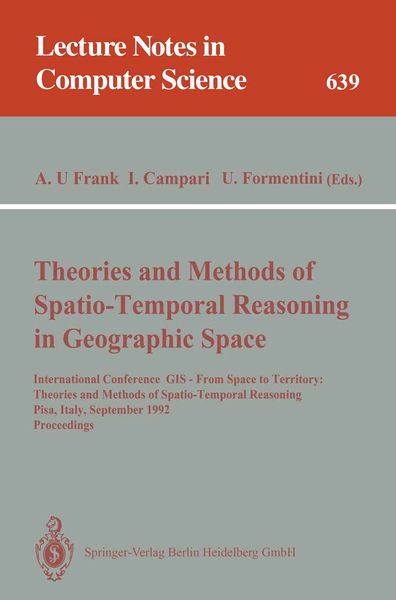
  • Produktbild: Theories and Methods of Spatio-Temporal Reasoning in Geographic Space
  • Produktbild: Theories and Methods of Spatio-Temporal Reasoning in Geographic Space
Band 639

Theories and Methods of Spatio-Temporal Reasoning in Geographic Space International Conference GIS - From Space to Territory: Theories and Methods of Spatio-Temporal Reasoning, Pisa, Italy, September 21-23, 1992. Proceedings

51,99 €

inkl. gesetzl. MwSt., Versandkostenfrei


Beschreibung

This volume collects the papers presented at the firstinternational conference dedicated to spatial and temporalreasoning in geographic space, entitled "GIS: from space toterritory - theories and methods of spatio-temporalreasoning".Within the National Center for Geographic Information andAnalysis (NCGIA,...

Beschreibung

This volume collects the papers presented at the firstinternational conference dedicated to spatial and temporalreasoning in geographic space, entitled "GIS: from space toterritory - theories and methods of spatio-temporalreasoning".Within the National Center for Geographic Information andAnalysis (NCGIA, one of the supporters of the conference)the importance of spatial and temporal reasoning wasrecognized several years ago. Initial research found thatspatial reasoning in geographic or large-scale space isdifferent from spatial reasoning in small-scale space, asusually dealt with in robotics and expertsystems. Temporalreasoning has attracted interest in the artificialintelligence community.The volume also includes two invited papers: "Do peopleunderstand spatial concepts: the case of first-orderprimtives" by R.G. Golledge, and "Temporal databases" byR.T. Snodgrass.

Produktdetails

Einband

Taschenbuch

Erscheinungsdatum

09.09.1992

Abbildungen

XIII, 439 p.

Herausgeber Andrew U. Frank + weitere

Produktdetails

Einband

Taschenbuch

Erscheinungsdatum

09.09.1992

Abbildungen

XIII, 439 p.

Herausgeber
Verlag Springer Berlin
Seitenzahl

439

Maße (L/B/H)

23,5/15,5/2,5 cm

Gewicht

680 g

Auflage

1992

Sprache

Englisch

ISBN

978-3-540-55966-5

Herstelleradresse

Springer-Verlag KG
Sachsenplatz 4-6
1201 Wien
AT

Email: ProductSafety@springernature.com

Noch keine Bewertungen vorhanden

Verfassen Sie die erste Bewertung zu diesem Artikel

Helfen Sie anderen Kundinnen und Kunden durch Ihre Meinung.

Kundinnen und Kunden meinen

Bewertungen (0)

  • Produktbild: Theories and Methods of Spatio-Temporal Reasoning in Geographic Space
  • Produktbild: Theories and Methods of Spatio-Temporal Reasoning in Geographic Space
  • Do people understand spatial concepts: The case of first-order primitives.- Temporal databases.- People manipulate objects (but cultivate fields): Beyond the raster-vector debate in GIS.- Time and space:An economic model.- The changing language of and persisting patterns in the urban design of Edo/Tokyo.- Toward a behavioral theory of regionalization.- Descriptive modeling and prescriptive modeling in spatial data handling.- The geometry of environmental knowledge.- Spatial reasoning using symbolic arrays.- Using orientation information for qualitative spatial reasoning.- The observer's point of view: An extension of symbolic projections.- Reasoning about gradual changes of topological relationships.- The meaning of “neighbour”.- A hierarchical triangle-based model for terrain description.- A model for expressing topological integrity constraints in geographic databases.- Encoding spatial information: The evidence for hierarchical processing.- Is there a relationship between spatial cognition and environmental patterns?.- Counter-intuitive geographic ‘facts’: Clues for spatial reasoning at geographic scales.- Spatial-linguistic reasoning in LEI.- User models and information theory in the design of a query interface for GIS.- A conceptual model of wayfinding using multiple levels of abstraction.- Towards acquiring spatio-temporal knowledge from sensor data.- Automatically acquiring knowledge by digital maps in artificial intelligence planning techniques.- Machine induction of geospatial knowledge.- Treatment of qualitative geographic information in monitoring environmental pollution.