KI-Beratung Beta

Gutscheinbedingungen

**Gültig bis 11.11.2026 auf Spielzeug, Schreibwaren, Filme, Geschenke & Trends, Musik, tolino eReader & Zubehör, Hörbücher und Hörbuch-Downloads, nicht preisgebundene Bücher und Kalender online auf thaalia.live und in der Thalia App. Einzelne Artikel können ausgeschlossen sein. Aufgrund der Buchpreisbindung sind deutschsprachige Bücher und eBooks ausgenommen. Zusätzlich ausgenommen sind Abos & Flatrates, Games, Geschenkkarten/-boxen, Shelfies, Software, Zeitschriften sowie einzelne Artikel von tonies®. Pro Einkauf einmal einlösbar. Click & Collect nur bei Onlinevorabzahlung möglich. Keine Barauszahlung. Nicht kombinierbar mit anderen Aktionen und Gutscheinen. Gutschein wird auf max. 500€ Bestellwert angerechnet. Nicht gültig für Versandkosten und Services.

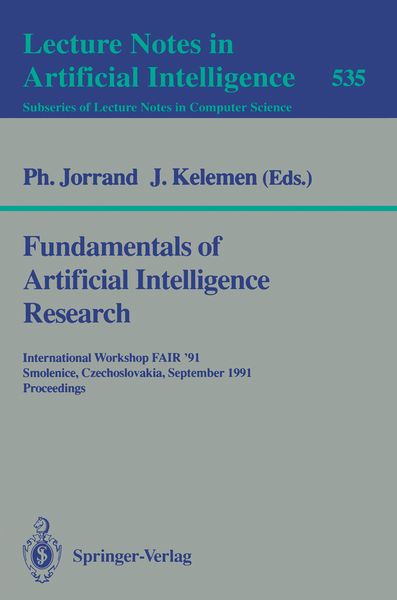
  • Produktbild: Fundamentals of Artificial Intelligence Research
  • Produktbild: Fundamentals of Artificial Intelligence Research
Band 535

Fundamentals of Artificial Intelligence Research International Workshop FAIR '91, Smolenice, Czechoslovakia, September 8-13, 1991. Proceedings

51,99 €

inkl. gesetzl. MwSt., Versandkostenfrei


Beschreibung

This volume contains 6 invited lectures and 13 submittedcontributions to the scientific programme of theinternational workshop Fundamentals of ArtificialIntelligence Research, FAIR '91, held at Smolenice Castle,Czechoslovakia, September 8-12, 1991, under the sponsorshipof the European Coordinating Committee...

Beschreibung

This volume contains 6 invited lectures and 13 submittedcontributions to the scientific programme of theinternational workshop Fundamentals of ArtificialIntelligence Research, FAIR '91, held at Smolenice Castle,Czechoslovakia, September 8-12, 1991, under the sponsorshipof the European Coordinating Committee for ArtificialIntelligence, ECCAI. FAIR'91, the first of an intendedseries of international workshops, addresses issues whichbelong to the theoretical foundations of artificialintelligence considered as a discipline focused on concisetheoretical description of some aspects of intelligence bytoolsand methods adopted from mathematics, logic, andtheoretical computer science. The intended goal of the FAIRworkshops is to provide a forum for the exchange of ideasand results in a domain where theoretical models play anessential role. It is felt that such theoretical studies,their development and their relations to AI experiments andapplications have to be promoted in the AI researchcommunity.

Produktdetails

Einband

Taschenbuch

Erscheinungsdatum

28.08.1991

Abbildungen

VIII, 260 p.

Herausgeber Philippe Jorrand + weitere

Produktdetails

Einband

Taschenbuch

Erscheinungsdatum

28.08.1991

Abbildungen

VIII, 260 p.

Herausgeber
Verlag Springer Berlin
Seitenzahl

260

Maße (L/B/H)

23,5/15,5/1,5 cm

Gewicht

417 g

Auflage

1991

Sprache

Englisch

ISBN

978-3-540-54507-1

Herstelleradresse

Springer-Verlag KG
Sachsenplatz 4-6
1201 Wien
AT

Email: ProductSafety@springernature.com

Noch keine Bewertungen vorhanden

Verfassen Sie die erste Bewertung zu diesem Artikel

Helfen Sie anderen Kundinnen und Kunden durch Ihre Meinung.

Kundinnen und Kunden meinen

Bewertungen (0)

  • Produktbild: Fundamentals of Artificial Intelligence Research
  • Produktbild: Fundamentals of Artificial Intelligence Research
  • User-oriented theorem proving with the ATINF graphic proof editor.- A modal analysis of possibility theory.- Making inconsistency respectable: A logical framework for inconsistency in reasoning, part I — A position paper.- Relational proof systems for some AI logics.- Formal grammars and cognitive architectures.- Efficient simulations of nondeterministic computations and their speed-up by the ring of cooperating machines.- A semantic characterization of disjunctive relations.- Execution of defeasible temporal clauses for building preferred models.- On the phenomenon of flattening “flexible prediction” concept hierarchy.- Possibilistic logic as a logical framework for min-max discrete optimisation problems and prioritized constraints.- An approach to data-driven learning.- Extending abduction from propositional to first-order logic.- Building in equational theories into the connection method.- Logical fiberings and polycontextural systems.- Automated deduction with associative commutative operators.- Towards a lattice of knowledge representation systems.- Inconsistencies handling: nonmonotonic and paraconsistent reasoning.- An approach to structural synthesis of data processing programs.- Negation as failure and intuitionistic three-valued logic.- Symbolic Computation and Artificial Intelligence.