KI-Beratung Beta

  • Produktbild: Wave Propagation in Viscoelastic and Poroelastic Continua
  • Produktbild: Wave Propagation in Viscoelastic and Poroelastic Continua
Band 2 - 12%

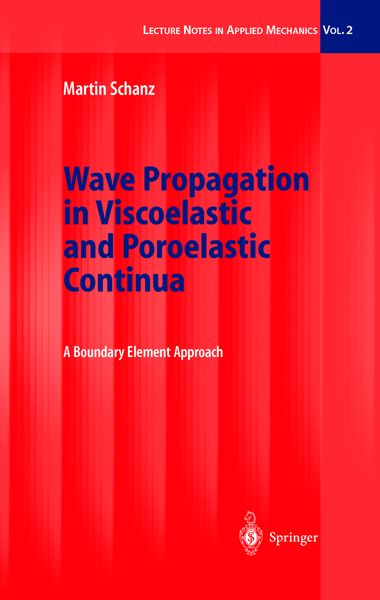
Wave Propagation in Viscoelastic and Poroelastic Continua A Boundary Element Approach

12% sparen

95,99 € UVP 109,99 €

inkl. gesetzl. MwSt., Versandkostenfrei


Beschreibung

Wave propagation is an important topic in engineering sciences, especially, in the field of solid mechanics. A description of wave propagation phenomena is given by Graff [98]: The effect of a sharply applied, localized disturbance in a medium soon transmits or 'spreads' to other parts of the medium....

Beschreibung

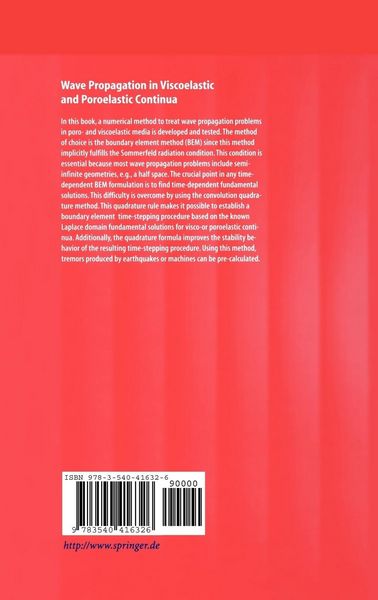
Wave propagation is an important topic in engineering sciences, especially, in the field of solid mechanics. A description of wave propagation phenomena is given by Graff [98]: The effect of a sharply applied, localized disturbance in a medium soon transmits or 'spreads' to other parts of the medium. These effects are familiar to everyone, e.g., transmission of sound in air, the spreading of ripples on a pond of water, or the transmission of radio waves. From all wave types in nature, here, attention is focused only on waves in solids. Thus, solely mechanical disturbances in contrast to electro-magnetic or acoustic disturbances are considered. of waves - the compression wave similar to the In solids, there are two types pressure wave in fluids and, additionally, the shear wave. Due to continual reflec tions at boundaries and propagation of waves in bounded solids after some time a steady state is reached. Depending on the influence of the inertia terms, this state is governed by a static or dynamic equilibrium in frequency domain. However, if the rate of onset of the load is high compared to the time needed to reach this steady state, wave propagation phenomena have to be considered.

Produktdetails

Einband

Gebundene Ausgabe

Erscheinungsdatum

08.05.2001

Abbildungen

X, 170 p.

Verlag Springer Berlin

Produktdetails

Einband

Gebundene Ausgabe

Erscheinungsdatum

08.05.2001

Abbildungen

X, 170 p.

Verlag Springer Berlin
Seitenzahl

170

Maße (B/H)

15,5/23,5 cm

Gewicht

416 g

Sprache

Englisch

ISBN

978-3-540-41632-6

Herstelleradresse

Springer-Verlag GmbH
Heidelberger Platz 3
14197 Berlin
Deutschland
Email: sdc-bookservice@springer.com
Url: www.springer.com
Telephone: +49 30 827870
Fax: +49 30 8214091

Noch keine Bewertungen vorhanden

Verfassen Sie die erste Bewertung zu diesem Artikel

Helfen Sie anderen Kundinnen und Kunden durch Ihre Meinung.

Kundinnen und Kunden meinen

Bewertungen (0)

  • Produktbild: Wave Propagation in Viscoelastic and Poroelastic Continua
  • Produktbild: Wave Propagation in Viscoelastic and Poroelastic Continua
  • 1. Introduction.- 2. Convolution quadrature method.- 2.1 Basic theory of the convolution quadrature method.- 2.2 Numerical tests.- 3. Viscoelastically supported Euler-Bernoulli beam.- 3.1 Integral equation for a beam resting on viscoelastic foundation.- 3.2 Numerical example.- 4. Time domain boundary element formulation.- 4.1 Integral equation for elastodynamics.- 4.2 Boundary element formulation for elastodynamics.- 4.3 Validation of proposed method: Wave propagation in a rod.- 5. Viscoelastodynamic boundary element formulation.- 5.1 Viscoelastic constitutive equation.- 5.2 Boundary integral equation.- 5.3 Boundary element formulation.- 5.4 Validation of the method and parameter study.- 6. Poroelastodynamic boundary element formulation.- 6.1 Biot’s theory of poroelasticity.- 6.2 Fundamental solutions.- 6.3 Poroelastic Boundary Integral Formulation.- 6.4 Numerical studies.- 7. Wave propagation.- 7.1 Wave propagation in poroelastic one-dimensional column.- 7.2 Waves in half space.- 8. Conclusions — Applications.- 8.1 Summary.- 8.2 Outlook on further applications.- A. Mathematic preliminaries.- A.1 Distributions or generalized functions.- A.2 Convolution integrals.- A.3 Laplace transform.- A.4 Linear multistep method.- B. BEM details.- B.1 Fundamental solutions.- B.1.1 Visco- and elastodynamic fundamental solutions.- B.1.2 Poroelastodynamic fundamental solutions.- B.2 “Classical” time domain BE formulation.- Notation Index.- References.